How to measure without a tape measure
Use things with a known size: a dollar bill is 6.14 in long, a credit card 3⅜ in, letter paper 11 in, or your iPhone's camera. Every method, with numbers.
 By the TapePal teamUpdated 5 min read
Short answer
6.14 in is the length of a US dollar bill, so you can measure with one. A credit card is 3⅜ × 2⅛ in, letter paper 8½ × 11 in and a quarter 0.955 in across. Or use your iPhone's camera as a tape measure.
How do you measure something without a tape?
Use something whose size you already know, and count how many times it fits. A dollar bill, a credit card and a sheet of letter paper are the same size everywhere in the US.
- Pick a reference Choose something whose size you know: a dollar bill, a credit card or a sheet of letter paper.
- Count lengths Lay it end to end along what you're measuring and mark where each length ends.
- Multiply Multiply the count by the reference's length, then measure the last bit against a shorter reference.
Say a shelf is 4 dollar bills long, plus the long side of a credit card. That is 4 × 6.14 = 24.56 in, plus 3⅜ in, so about 28 in.
What has a known size?
A dollar bill is 6.14 in long, a credit card is 3⅜ × 2⅛ in, letter paper is 8½ × 11 in and a quarter is 0.955 in across. Pick the one closest in size to what you’re measuring.
| Object | Size | Good for | In cm |
|---|---|---|---|
| US dollar bill | 6.14 × 2.61 in | Lengths up to a few feet | 15.6 × 6.6 cm |
| Credit card | 3⅜ × 2⅛ in | Small things, the last few inches | 8.56 × 5.4 cm |
| Letter paper | 8½ × 11 in | Longer lengths, square corners | 21.6 × 27.9 cm |
| Quarter | 0.955 in across | Anything under an inch | 2.43 cm |
| Standard interior door | 80 in tall | Checking heights in a room | 203 cm |
Letter paper folds into a ruler. The long side is 11 in; fold the sheet in half across it and that edge is 5½ in, fold again and it is 2¾ in.
Can you measure with your body?
Yes, once you know your own numbers. Measure your hand span (thumb tip to little finger, hand spread) against a dollar bill, and your stride against a row of letter paper sheets laid end to end. Write them down and reuse them.
A stride is good for rooms and yards: walk at a normal pace, count your steps and multiply by your stride. A hand span is good for a table or a shelf. Neither is precise enough to order furniture or cut wood. Measuring yards with a device you walk instead? See Moasure alternatives.
Can you use your phone instead?
Yes. Your iPhone’s camera can measure lengths in AR: point it at one end, tap, move to the other end, tap. For small things, an on-screen ruler shows inches at actual size: lay the object on the glass and read it.
Phone measurements are for planning. Before you cut or order, check the number with a real tape. Is the iPhone Measure app accurate? explains what changes the result.
Thinking of buying a tape with a screen or a laser instead? See digital tape measure for how they compare with a phone, and the laser measure guide for how close a laser gets.
Can your iPhone measure it?
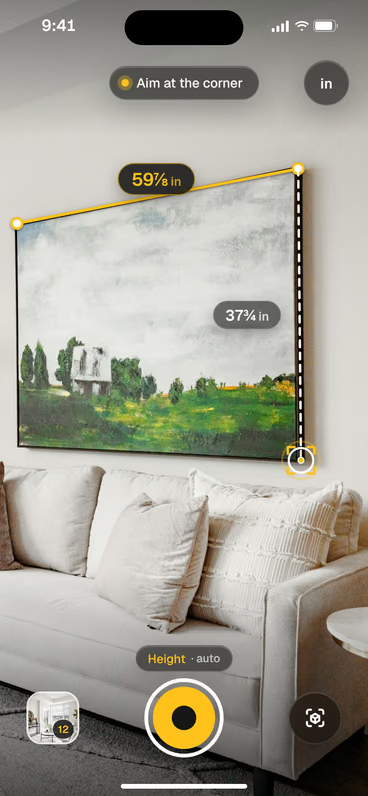
59⅞ in wide, read in two taps. Aim at one corner, tap, move to the other, tap. TapePal shows the length in feet and inches and saves it with the photo.

More on using your iPhone as a tape, and how close it gets, on our tape measure app page.
Questions
How long is a dollar bill?
6.14 in long and 2.61 in wide. Every current US note, from $1 to $100, is the same size.
How big is a credit card?
About 3⅜ × 2⅛ in. Most bank cards, driver's licenses and gift cards share this size.
Can I use my phone as a tape measure?
Yes, for planning: the camera measures lengths in AR. Check with a real tape before you cut or order.
How can I measure 1 inch without a ruler?
Use a quarter: it is 0.955 in across, just under an inch. The top joint of many adults' thumbs is close to an inch too, but check yours once against a dollar bill.
How do I take body measurements without a tape measure?
Wrap a piece of string or a phone cable around, pinch where it meets, then lay it along dollar bills or letter paper and add up the lengths.
How do I measure a long distance without a tape?
Pace it: measure your stride once against something known, then count steps. Good for rooms and yards, not for furniture.
How we checked this. Note size from the Bureau of Engraving and Printing, quarter diameter from the US Mint, and card size from ISO/IEC 7810 ID-1 (85.60 × 53.98 mm, about 3⅜ × 2⅛ in). Letter paper is the US standard 8½ × 11 in. Reviewed by the TapePal team on .