How to read a tape measure
 By the Tapepal teamUpdated 6 min read
Quick answer
Every inch is split into 16 marks. Find the last number before your mark, then count the short lines after it: each one is 1/16 in. Two make 1/8, four make 1/4, eight make 1/2.
On this page5 sections
Find the inch marks first
The numbers on a tape are whole inches, and the long line under each number marks the exact spot. If your edge lands just past the 3, you already know the answer is 3 and a bit. Everything after this is working out the bit.
Most tapes also have a red number every 16 inches, for wall studs, and a small black diamond every 19.2 inches, for joists. You can ignore both unless you are building a wall.
Halves, quarters and eighths
Between two numbers, the second-longest line is the half. The two lines either side of it are the quarters, and the lines between those are the eighths. The shortest lines of all are sixteenths.
| Fraction | In sixteenths | Decimal | Millimeters |
|---|---|---|---|
| 1/16 | 1/16 | 0.0625 | 1.6 |
| 1/8 | 2/16 | 0.125 | 3.2 |
| 1/4 | 4/16 | 0.25 | 6.4 |
| 3/8 | 6/16 | 0.375 | 9.5 |
| 1/2 | 8/16 | 0.5 | 12.7 |
| 5/8 | 10/16 | 0.625 | 15.9 |
| 3/4 | 12/16 | 0.75 | 19.1 |
| 7/8 | 14/16 | 0.875 | 22.2 |
 Skip the counting.Point your iPhone at the edge and Tapepal reads it to 1/16 in.Get Tapepal
Count the sixteenths
- Find the last whole numberSay your edge is just past the 3.
- Count the short lines after itTen lines after the 3 means ten sixteenths.
- Simplify if you want to10/16 is the same as 5/8. So the reading is 3 5/8 in.
Feet and inches on a long tape
Past 12, most tapes also count feet. You may see a small 1F or 1′ after the 12, and some tapes print 13 as 1′ 1″. To turn inches into feet, take off 12 at a time: 63 in is 5′ 3″, five feet and three inches.
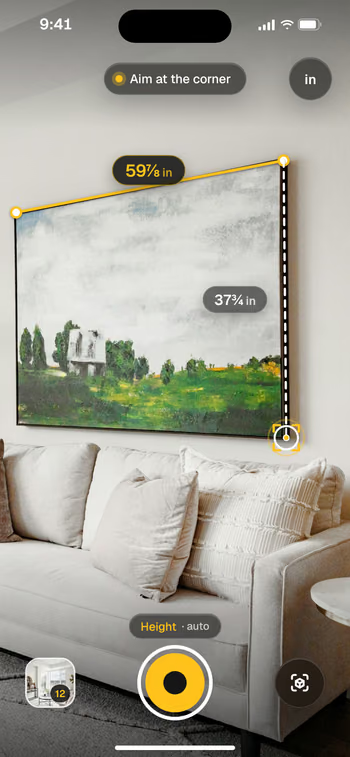
Or let your phone read it

Questions
Why are some numbers on my tape red?
Red numbers mark every 16 inches. That is the standard spacing for wall studs in the US, so builders can find them quickly.
What are the black diamonds?
They mark every 19.2 inches, a spacing used for floor joists and roof trusses.
Why does the hook at the end move?
It slides by its own thickness, so the reading is right whether you hook it over an edge or push it against a wall.