Stair railing height: 34–38 in, by code
Stair railing height: a handrail goes 34 to 38 in above the nosings, and guards at landings and decks must be at least 36 in in homes. How to check.
 By the TapePal teamUpdated 4 min read
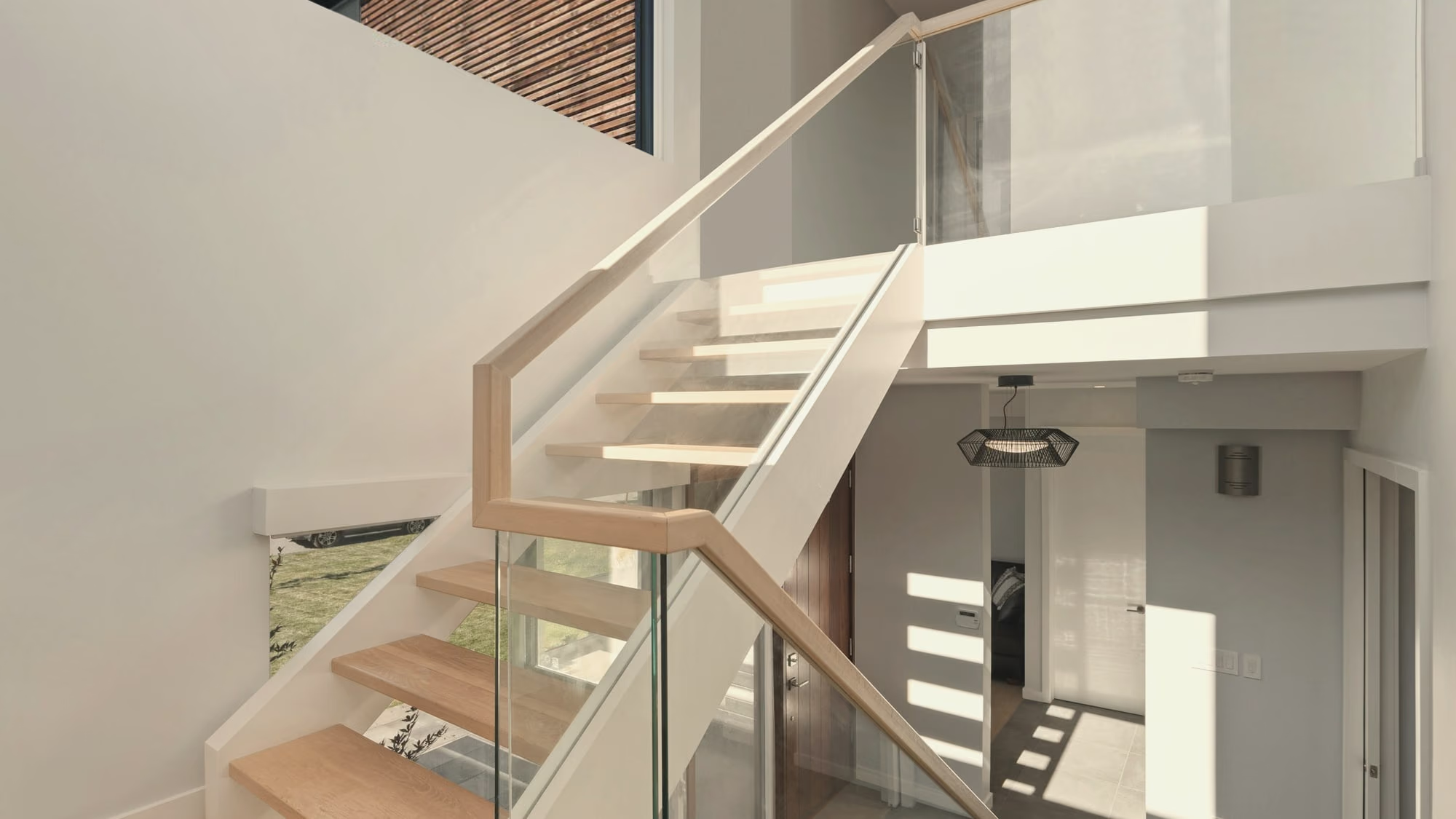
Short answer
34–38 in above the line of the stair nosings is the height for a stair handrail in homes (IRC R311.7.8). A guard at a landing, porch or deck must be at least 36 in high in homes (34 in along the open side of the stair itself), and 42 in in most commercial buildings.
What does the code say about stair railings?
In a home, the handrail goes 34 to 38 in above the nosing line, and a guard at any drop of more than 30 in must be at least 36 in high. The nosing line is the slope you get by joining the front edges of the treads. Commercial buildings use the same handrail height but taller guards.
| Rule | Homes (IRC) | Commercial (IBC) |
|---|---|---|
| Handrail height | 34–38 in | 34–38 in |
| Guard height | 36 in min (34 in on stair sides) | 42 in min |
| Gaps in a guard | 4 in ball can't pass (4⅜ in on stairs) | 4 in ball can't pass |
| Round handrail | 1¼–2 in across | 1¼–2 in across |
| Gap to the wall | 1½ in min | 1½ in min |
A handrail is the rail you hold. A guard is the barrier that stops a fall off an open side, like the railing around a landing. On the open side of a stair, one rail can do both jobs if its top sits between 34 and 38 in.
These are the model codes most US towns adopt. Local codes can differ, and the building inspector has the final word.
Is handrail height different for ADA and OSHA?
Public buildings under the ADA use the same 34 to 38 in above the stair nosings. Workplaces under OSHA allow a little lower: 30 to 38 in, measured from the leading edge of the tread.
| Standard | Handrail height | Applies to | Height in cm |
|---|---|---|---|
| IRC | 34–38 in | Homes | 86–97 cm |
| IBC | 34–38 in | Commercial and multi-family buildings | 86–97 cm |
| ADA | 34–38 in | Public buildings, accessible routes | 86–97 cm |
| OSHA | 30–38 in | Workplaces | 76–97 cm |
When do you need a handrail on stairs?
You need a handrail once a flight has four or more risers, on at least one side. A riser is the upright face of each step, so four risers means four steps up.
Short flights of one to three steps don’t need one under the IRC. Many towns ask for one anyway, and on outdoor steps it is worth adding.
How do you measure stair railing height?
Measure straight up from the nosing to the top of the rail: it should read 34 to 38 in. Hold the tape plumb, not along the slope of the stair.
- Find the nosing The nosing is the front edge of a tread. Stand your tape on it.
- Measure straight up Hold the tape plumb and read the height to the top of the rail.
- Check three treads Measure at the top, middle and bottom of the flight. All three should read 34 to 38 in.
How high should a deck railing be?
A home deck or porch needs a guard at least 36 in high once its floor is more than 30 in above the ground. Measure from the deck boards to the top of the rail. Below 30 in, the IRC does not require a guard, though many people add one. Decks on commercial buildings need 42 in.
The gaps follow the same rule as the stairs: a 4 in ball must not fit between the balusters.
For the steps themselves, the rise, the run and the width, see stair dimensions.
Can your iPhone measure it?
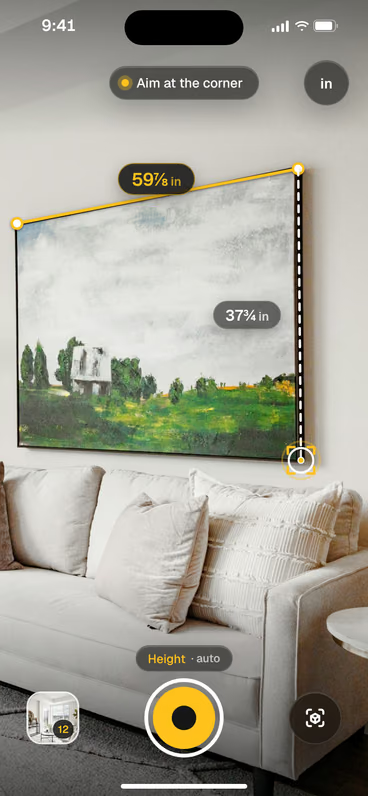
Nosing to rail, in two taps. Aim at the front edge of a tread and tap, then move up to the top of the rail and tap again. TapePal shows the height in inches and saves it with the photo.

Questions
Is a stair railing 36 or 42 in high?
Neither, for the handrail you hold: it goes 34 to 38 in above the nosings. 36 in is the minimum guard height at a landing or deck in a home, and 42 in the guard height in most commercial buildings.
Is a 42 in railing too high?
For a stair handrail, yes: the IRC caps it at 38 in. For a guard around a landing, deck or balcony, 42 in is fine, because the code sets only a minimum.
Where should a handrail start and end?
It runs the whole flight without a break, from above the top riser to above the bottom riser (IRC R311.7.8). Measure along the nosings from top to bottom to get its length. The ends turn into the wall or stop at a newel post.
How far apart can balusters be?
Close enough that a 4 in ball cannot pass through (4⅜ in on the stair itself).
How thick should a handrail be?
A round rail is 1¼ to 2 in across, with at least 1½ in between the rail and the wall.
How we checked this. Homes: IRC 2021 R311.7.8 (handrails) and R312 (guards). Commercial buildings: IBC 2021 1014 and 1015. Public buildings: ADA 2010 Standards 505.4, 34 to 38 in above stair nosings. Workplaces: OSHA 29 CFR 1910.29(f)(1), 30 to 38 in from the leading edge of the tread. Codes vary by town; check with your building department. Read 26 Nov 2026. Reviewed by the TapePal team on .