How to measure a table and other furniture
How to measure furniture: a table's length, width and height, a dresser, chair, desk, sectional and mirror, then the doorway it has to pass through.
 By the TapePal teamUpdated 6 min read
Short answer
Measure a table length × width × height: end to end along the top, side to side, and from the floor to the top of the tabletop. For a round table, measure the diameter across the middle. Most other furniture is listed width × depth × height, measured at the widest, deepest and highest points.
How do you measure a table?
Measure the top end to end for the length, side to side for the width, and the floor to the top of the tabletop for the height. Write it length × width × height. A typical dining table for six is about 72 × 36–40 × 30 in.
- Measure the length Measure the tabletop end to end along one long edge, at the widest point. Include any overhang or trim. With leaves, measure it closed and again with every leaf in.
- Measure the width Measure side to side across the top, at the widest point. For a round table, measure straight across through the center: that is the diameter.
- Measure the height Measure from the floor straight up to the top of the tabletop. Then measure from the floor to the underside of the apron, the rail under the top, to check knee room.
What do you measure on each piece of furniture?
Measure every piece at its widest, deepest and highest points, and write it width × depth × height. Here is where the tape goes on the pieces people measure most:
| Piece | What to measure | Typical size | cm |
|---|---|---|---|
| Dining table | Length × width × height, closed and with leaves in | 72 × 36–40 × 30 in for six | 183 × 91–102 × 76 |
| Round table | Diameter through the center, and height | 36–48 in across, 30 in high | 91–122 across |
| Dresser | Width × depth × height, plus inside drawer depth | 60 × 18 × 34 in double dresser | 152 × 46 × 86 |
| Dining chair | Seat height, seat depth, overall height and width | 18 in seat, 36 in overall | 46 and 91 |
| Desk | Width × depth × height, and the knee space | 48–60 × 24–30 × 29–30 in | 122–152 × 61–76 × 74–76 |
| Sectional | Each section, then each side of the L overall | Pieces about 30–40 in deep | 76–102 deep |
| Mirror | Width × height of the outside of the frame | 24 × 36 in over a vanity | 61 × 91 |
How do you measure a dresser?
Measure the width across the top at its widest, including any trim, the depth from the wall to the front of the drawer pulls, and the height from the floor to the top. Then open a drawer and measure inside it, front to back: that is the depth you can actually use, usually a few inches less than the dresser.
Leave room in front for the drawers. A drawer pulled all the way out takes its full depth, plus the space to stand behind it, so plan on about 36 in clear in front of a dresser.
How do you measure a chair or a recliner?
For a dining chair, measure four things:
- Seat height: from the floor to the top of the seat at the front edge. Most dining chairs are 17 to 19 in, which leaves 10 to 12 in up to a 28–30 in table (standard table height).
- Seat depth: from the front edge of the seat to the backrest.
- Arm height: from the floor to the top of the arm. It has to clear the underside of the table’s apron to slide in.
- Overall: width, depth and height at the widest points, back and legs included.
For a recliner or an armchair, measure the width arm to arm, the height to the top of the back, and the depth twice: upright, and fully reclined with the footrest out.
How do you measure a desk?
Measure the desktop width side to side and depth front to back, then the height from the floor to the top. Most desks are 28 to 30 in high (standard desk height). Then measure the knee space: the clear width between the legs or drawers, and the height from the floor to the underside of the desk or keyboard tray.
How do you measure a sectional?
Measure each piece on its own, then the whole shape. For each section, write the width, depth and height. Then, with the pieces together, measure each side of the L from the outside corner to the end of the arm. For a chaise, measure how far it sticks out from the back of the sofa.
Sectional pieces are named for where the arm is when you face the sofa: a left-arm-facing piece has its arm on your left. Check that before you order one side. To get it into the house, only the biggest single section has to clear the door.
How do you measure a mirror?
Measure the outside of the frame, width then height, and measure a round mirror straight across through the center. Over a bathroom vanity, a mirror usually looks best a few inches narrower than the vanity. Weigh a big mirror, or check its weight on the product page, before you pick the hanging hardware.
Game tables need the most room of all: pool table dimensions gives the table sizes and the room each one needs to play.
Will it fit through the door?
A piece that fits the room still has to get there. Measure every door between its stops, every hallway, and every turn on the way in, using how to measure a doorway. Then compare the piece with the door: the smallest of its three sizes has to be less than the door width, and the middle one less than the door height.
Will my couch fit through the door? walks through it upright, on its back and on its end. Planning where it goes once inside? How to measure a room for furniture has the walkways and clearances to keep.
Can your iPhone measure it?
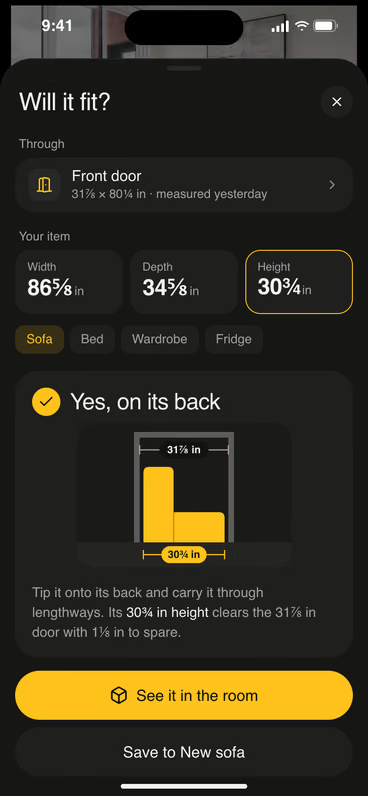
Yes, on its back. Measure the doorway with TapePal, type the piece from the product page, and see which way it goes through and how much room is left. It checks every door on the way, and can place the piece at full size in your room.

More on how it works: the Will it fit app.
Questions
What order are furniture dimensions written in?
Width × depth × height for most furniture, so a 60 × 18 × 34 in dresser is 60 in wide, 18 in deep and 34 in high. Tables are often listed length × width × height.
How do I measure a round or oval table?
A round table is sold by its diameter: measure straight across through the center. An oval table has a length and a width, measured across the middle both ways. Add the height from the floor to the top.
How much room do I need around a dining table?
About 36 in from the edge of the table to a wall or other furniture, so chairs can pull out and people can walk behind them. Each diner needs about 24 in of table edge.
How do I measure a recliner?
Measure the width, the height and the depth upright, then recline it all the way and measure the depth again, from the back to the end of the footrest. Leave that much floor, plus the space the maker asks for behind it. Wall-hugger recliners need only a few inches.
Do I include the handles when I measure a dresser?
Yes, if you are checking it fits a space or a doorway. Pulls and knobs add about 1 in to the depth. Product pages often list the depth of the case without them.
How we checked this. Measuring order (width × depth × height for furniture, length × width × height for tables) is the convention US furniture makers use on product pages. Table and seat heights match our standard table height guide: tables 28–30 in, dining chair seats 17–19 in. Desk heights match our standard desk height guide. The 36 in around a dining table and 24 in per diner are common interior-design guidelines, not a building code. Furniture sizes in the examples are typical, so measure your own. Reviewed by the TapePal team on .