An 84 × 36 × 32 in sofa through a 30 in door?
No 4 in too wide
A 30 in door leaves about 28 in. Even on its back, it is 4 in too wide.
Will my sofa fit? Type the sofa and the doorway, and this calculator shows which way it goes through: upright, on its back or on its end, with the inches to spare.
Doors measured between the stops: a 30 in door leaves about 28 in, a 32 in door about 30 in, a 36 in door about 34 in. Tap one to load it above.
No 4 in too wide
A 30 in door leaves about 28 in. Even on its back, it is 4 in too wide.
No 2 in too wide
A 32 in door leaves about 30 in. Even on its back, it is 2 in too wide.
Yes on its back
32 in across: 2 in to spare.
Yes on its side
12 in thick: 16 in to spare.
Yes on its side
12 in thick: 4 in under the door height.
2 in
A 32 in door leaves about 30 in to carry through.
How to measure a doorway1½ in
An open door left on its hinges takes about 1½ in of the opening.
24–36 in
Most are 30 or 32 in wide and 80 in tall.
Standard door sizesThree sofa sizes and two door sizes. The side you carry across the doorway has to be smaller than the door width, so the depth or the height usually decides it, not the width.
| Way to carry it | Must be smaller than the door width | Our example |
|---|---|---|
| Upright | Depth | No, 2¾ in too wide for the door |
| On its back | Height | Yes, 1⅛ in to spare |
| On its end | Depth or height, and the width under the door height | No, 6⅜ in too tall for the door |
It is how deep the sofa is when you tip it back, and it can get a sofa through when the depth and height are both too big. Take the cushions off. Lay a yardstick from the top of the back to the front edge of the arm. Then measure from the back bottom corner of the sofa straight to the yardstick. If that number is smaller than the door width, you can usually tip the sofa back and angle it through.
Asking whether your couch will fit through your door, and which way to carry it? Our guide will my couch fit through the door answers it, with what fits through a 30, 32 or 36 in door. To measure the opening, see how to measure a doorway and standard door sizes. To check every door on the way with your iPhone camera, see the Will it fit app.
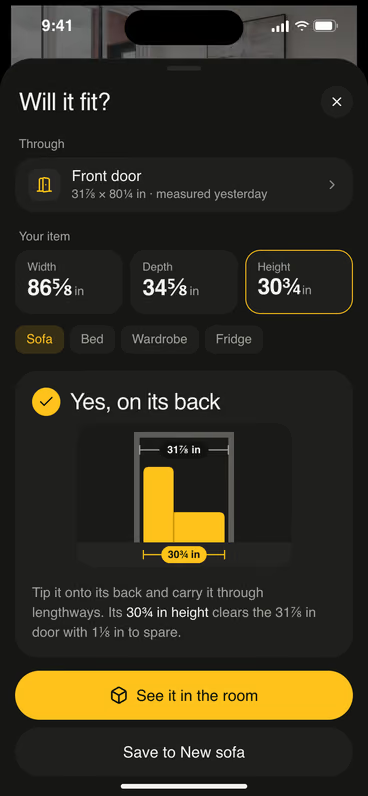
Measure the doorway once with TapePal, type the sofa from the product page, and Will it fit tells you which way it goes through and how much room is left.

Only when you carry it on its end, where the width has to be less than the door height. Upright or on its back, the width runs along the hallway.
If it is close, yes. An open door takes about 1½ in of the width between the stops. Change “off its hinges” to “on its hinges” to see the difference.
Many sofas have screw-on feet. Taking them off makes the sofa lower, which can be what gets it through on its back.
Yes. Pick a mattress, a fridge or something else and type its three sizes. The same three ways apply.
Change “no hallway corner” to “a hallway corner” and type the hallway width. The calculator works out the longest piece that can be carried flat round a right-angle corner of that width and compares it with the longest side.
There is less than about ¾ in to spare, the same line the TapePal app draws. It should go, but wrap it and measure twice.
How we checked this. The same rules as our guide “Will my couch fit through the door?”: the side you carry across the doorway must be smaller than the width between the stops. An open door takes about 1½ in and a door's opening is about 2 in less than its size, as in our doorway guide. The diagonal-depth check follows the furniture makers' own delivery measuring guides (Pottery Barn's How to Measure guide, Crate & Barrel's how to measure furniture, Costco's Measuring for Delivery): no standards body publishes it. The corner check is the TapePal app's: the longest piece that can be carried flat round a right-angle turn. Mattresses are taken as 12 in thick; the sofa and fridge presets are typical sizes, not standards. The example is the TapePal demo. Reviewed by the TapePal team, November 16, 2026.
 Check it fits before you buy.TapePal on the App StoreGet
With your OK, Google Analytics sets cookies so we can see which guides and tools help. No ads. Change it any time under Cookie settings, at the bottom of every page. Privacy