Standard tile sizes, from 3 × 6 to 24 × 48 in
Standard tile sizes: 12 × 12, 12 × 24 and 24 × 24 in for floors, 3 × 6 in subway tile for walls, planks to 8 × 48 in. Tiles per sq ft and real sizes.
 By the TapePal teamUpdated 5 min read
Short answer
12 × 12, 12 × 24 and 24 × 24 in are the standard floor tile sizes in US stores, with 3 × 6 in subway tile the classic for walls. Wood-look planks run from 6 × 24 to 8 × 48 in, and mosaics come as 2 × 2 in pieces on 12 × 12 in sheets. These are nominal sizes: the box gives the real one.
What are the standard tile sizes?
For floors, 12 × 12, 12 × 24 and 24 × 24 in are the sizes most US stores stock in depth, with 18 × 18 in and large 24 × 48 in slabs too. Walls and backsplashes often get 3 × 6 in subway tile or 4 × 12 in. Wood-look porcelain comes in planks from 6 × 24 to 8 × 48 in.
| Tile | Size | cm | Tiles per 100 sq ft | Used for |
|---|---|---|---|---|
| Mosaic | 2 × 2 in (on a 12 × 12 in sheet) | 5 × 5 | 3,600 (100 sheets) | Shower floors, accents |
| Subway | 3 × 6 in | 8 × 15 | 800 | Walls, backsplashes |
| Square | 12 × 12 in | 30 × 30 | 100 | Floors, walls |
| Rectangle | 12 × 24 in | 30 × 61 | 50 | Floors, shower walls |
| Square | 18 × 18 in | 46 × 46 | 45 | Floors |
| Square | 24 × 24 in | 61 × 61 | 25 | Large floors |
| Plank | 6 × 24 in | 15 × 61 | 100 | Wood-look floors |
| Plank | 8 × 48 in | 20 × 122 | 38 | Wood-look floors |
| Slab | 24 × 48 in | 61 × 122 | 13 | Floors, feature walls |
To get the count for any tile, divide 144 by its area in square inches: that is the tiles in one square foot. A 12 × 24 in tile is 288 sq in, so half a tile covers a square foot.
Why is the real size smaller than the label?
Because 12 × 24 in is a nominal size. Many tiles are made to metric sizes, so a “12 × 24” is often 30 × 60 cm, about 11⅞ × 23⅝ in, and the grout joint makes up the rest. The real size is printed on the box. US tile is made to ANSI A137.1, the American standard for ceramic tile, which lets the size vary a little from tile to tile.
- Rectified tile is ground square after firing, so every edge is the same and joints can be thin.
- Calibrated (not rectified) tile varies more and needs a wider joint.
The grout joint has to absorb that variation. ANSI A108.02 asks for a joint at least three times the tiles’ size variation, and never under 1/16 in. For tiles with a side over 15 in laid in a running bond, it asks for an average of at least 1/8 in for rectified tile and 3/16 in for calibrated tile.
What counts as large-format tile?
Since January 2024, the ANSI A108 installation specifications define large-format tile as a tile with a side longer than 23 in. Before that, the trade often used 15 in as the line. Big tiles need a flatter floor: the Tile Council of North America cites ANSI A108.02 at no more than 1/8 in in 10 ft for tiles with an edge of 15 in or more, against 1/4 in in 10 ft for smaller tiles.
How many tiles do you need?
Work out the area, add the extra for cuts, then divide by what one box covers.
- Measure the floor or wall Measure wall to wall in feet and multiply for the square feet. Split an L-shaped room into rectangles and add them up. Leave out the spots under a tub or built-in cabinets.
- Pick the size and read the box Choose the tile, then read its real size and the square feet per box on the label. A 12 × 24 in tile is often 11⅞ × 23⅝ in, because many tiles are made to 30 × 60 cm.
- Add the extra and count boxes Add 10% for cuts on a straight layout, 15% on a diagonal one, then divide by the square feet per box and round up.
For a 5 × 8 ft bathroom floor, that is 40 sq ft. In 12 × 24 in tile, 20 tiles cover it, and with 10% extra you buy 22. On a diagonal layout, add 15%: more tiles get cut at the edges.
Can your iPhone work out the tile?
Yes. In TapePal, tap each corner of the floor and close the shape, or scan the whole room on a Pro iPhone with LiDAR (tap the floor corners on any other iPhone). You get the floor area in square feet. Flooring then adds 5, 10 or 15% for cuts and counts the boxes: type the square feet printed on your tile box as the box size.
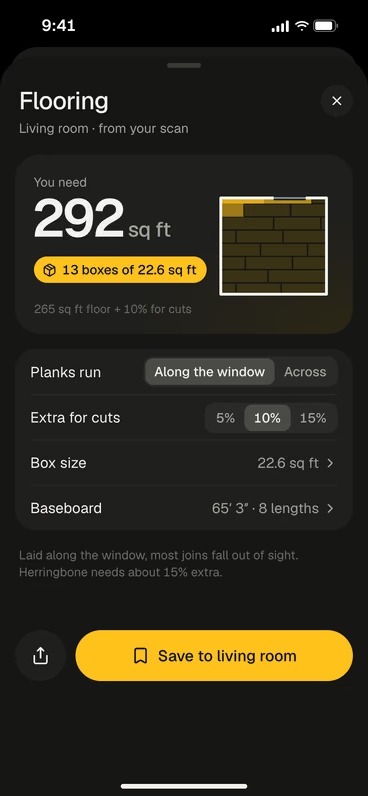
Square feet in, boxes out. TapePal takes the floor area from the room, adds the extra you choose and tells you how many boxes to buy, in your box size.

The same plan gives the wall area for a backsplash or shower wall, and exports as a PDF report or a CSV with a takeoff to send to a tile shop. More on what TapePal works out from a room on our paint and flooring app page. Hanging new walls first? See drywall sheet sizes, and for the trim around the tile, the perimeter calculator guide.
Questions
Is a 12 × 12 tile really 12 inches?
Not always. 12 × 12 in is the nominal size; the real size is printed on the box and can be a little smaller, so the tile plus the grout joint comes close to 12 in. Plan the layout with the real size.
What size is subway tile?
The classic subway tile is 3 × 6 in. Larger versions such as 4 × 12 in and 2 × 8 in are sold as subway tile too.
How many 12 × 24 tiles do I need for 100 sq ft?
50 tiles cover 100 sq ft, since each is 2 sq ft. Add 10% for cuts and buy 55, or more boxes if the count doesn't round to whole boxes.
What size tile is best for a small bathroom?
There is no rule. Larger tiles mean fewer grout lines and can make a floor look calmer; small mosaics like 2 × 2 in follow the slope to a shower drain more easily, which is why they are common on shower floors.
What grout joint does a 12 × 24 tile need?
It depends on how even the tiles are. ANSI A108.02 asks for a joint at least three times the tiles' size variation and never under 1/16 in; for tile over 15 in long in a running bond, an average of at least 1/8 in for rectified tile and 3/16 in for calibrated tile.
How we checked this. Sizes are the nominal sizes US tile shops and makers list. Tiles per square foot are worked out from those sizes (144 sq in in a square foot). The grout joint minimums are from ANSI A108.02 (4.3.8 and 4.3.8.1), as quoted by the Ceramic Tile Education Foundation and Stone World; TileLetter gives the same 1/16 in floor. The large-format definition (a side over 23 in) is from the ANSI A108 specifications of January 2024, as quoted by Floor Trends. The floor flatness figures are the ones the Tile Council of North America cites from ANSI A108.02. The 10% and 15% extra for cuts match our tile calculator and the app's flooring answer. Stone World, Floor Trends and TCNA last checked November 10, 2026; CTEF and TileLetter read 26 Nov 2026. Reviewed by the TapePal team on .