How to measure for replacement windows
To measure for replacement windows, take 3 widths and 3 heights inside the frame and keep the smallest, to the nearest ⅛ in. Inside and outside blinds too.
 By the TapePal teamUpdated 6 min read
Short answer
The smallest of 3 readings each way: measure the width between the jambs at the top, middle and bottom, and the height from the sill to the head jamb at the left, center and right, to the nearest ⅛ in. Inside-mount blinds are the one exception: keep the narrowest width but the longest height.
How do you measure a window for replacement?
Take three widths and three heights inside the frame and keep the smallest of each: a window that fits the tightest spot fits everywhere. Blinds use the same three readings; which one to keep is in the table below.
- Measure the width Inside the frame, measure from one side jamb to the other at the top, middle and bottom. Write down the smallest.
- Measure the height Measure from the sill up to the head jamb at the left, center and right. Write down the smallest.
- Check the depth Measure the frame from front to back, so you know the new window fits the space the old one sits in.
Write the size as width × height, always in that order. Window companies read the first number as the width, and mixing them up is an easy mistake that costs a whole window. Replacing a bedroom or basement window? Measure the open gap too: an escape window has its own minimums, in our egress window size guide.
What is the best app to measure windows for blinds?
TapePal, which we make. Point your iPhone at the window and TapePal finds it: one tap gives the width, the height and the glass area, and you can switch between the glass and the outer frame. For the three widths and three heights a blind order asks for, the camera tape takes each one in two taps, in inches to the nearest ⅛ or 1/16 in. Every reading is saved with its photo and sorted by room, so the kitchen and bedroom windows don’t get mixed up, and you can send the photo with the sizes drawn on to whoever makes the blinds. It works on any iPhone with iOS 26: Pro iPhones from the iPhone 12 Pro on read depth with LiDAR, and other iPhones calibrate once with a bank card.
A camera reading is close, not tape-exact, and blinds are cut to your numbers. Check the narrowest width with a steel tape before you order.
With a phone or a tape, the steps on this page are the same.
Which number do you use for windows and for blinds?
The rule changes with the job. Replacement windows and inside-mount blinds both need the narrowest width, but blinds take the longest height so no light shows under them.
| Job | Width | Height |
|---|---|---|
| Replacement window | Jamb to jamb, 3 places: smallest | Sill to head jamb, 3 places: smallest |
| Inside-mount blinds | Inside the frame, 3 places: narrowest | Top of the opening to the sill, 3 places: longest |
| Outside-mount blinds | The area to cover, plus 1½–3 in each side | Headrail to below the sill, plus 1½–3 in |
Do you measure inside the frame or the rough opening?
It depends on the kind of replacement. Many replacement windows are inserts: the new window slides into your old frame, so you measure inside that frame, jamb to jamb and sill to head jamb. Leave the trim on.
A full-frame replacement takes out the old frame too. Then you measure the rough opening, the hole in the wall, which means taking off the inside trim first. If you aren’t sure which one you’re buying, take both sets of numbers.
How much smaller is the new window?
A little, and that’s on purpose. Makers usually leave about ¼ in on each side, so the window comes about ½ in smaller than the opening. That gap is where the shims and sealant go.
Give the company the smallest numbers exactly as you measured them. Don’t take anything off yourself unless their order form asks you to, or the gap ends up twice as big.
How do you measure for inside-mount blinds?
Inside-mount blinds sit within the window frame, so they have to clear the narrowest point.
- Width: measure inside the frame at the top, middle and bottom. Use the narrowest. Don’t take anything off: the maker does that.
- Height: measure from the top of the opening to the sill at the left, center and right. Use the longest, so the blind reaches the sill everywhere.
- Depth: measure how deep the frame is. Check it against the blind’s minimum mounting depth on the product page. If the frame is too shallow, go for an outside mount.
How do you measure for outside-mount blinds?
Outside-mount blinds hang on the wall or the trim, over the window. Measure the area you want covered, not the window. Then let the blind overlap the opening by 1½ to 3 in on each side, and the same at the top and bottom, so light can’t leak around the edges. Add that overlap to your numbers before you order. The maker won’t add it for you.
How do you measure for roman shades?
The same way as blinds: decide the mount first, then take three widths and three heights.
- Inside mount: measure the width inside the frame at the top, middle and bottom and give the narrowest, with nothing taken off. Measure the height from the top of the opening to the sill at the left, center and right and give the longest. Check the frame depth against the shade’s minimum mounting depth on the product page.
- Outside mount: measure the area you want covered and add the overlap on each side yourself, as for outside-mount blinds. A roman shade folds into a stack at the top when you raise it, so mounting it above the frame keeps that stack off the glass.
What does this look like for a real window?
Our demo window measures 42¼ × 96 in. Here is what you would order for each job:
- Replacement window: 42¼ × 96 in, the smallest width and height. The maker builds it about ½ in smaller.
- Inside-mount blinds: 42¼ in wide, the narrowest width, and the longest of your three heights.
- Outside-mount blinds: with 3 in of overlap on each side, 42¼ + 6 = 48¼ in wide.
Can your iPhone measure it?
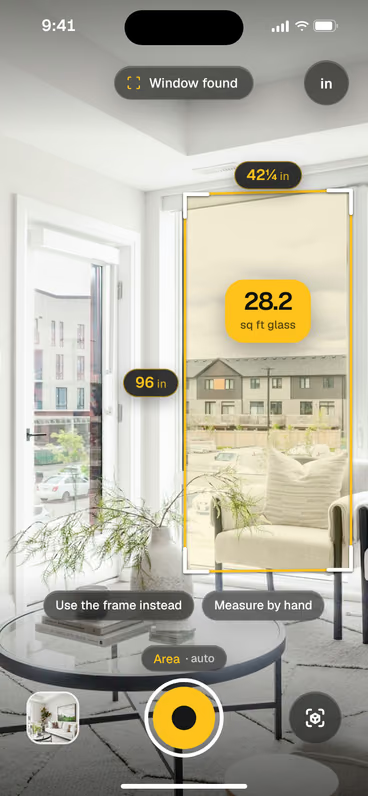
Window found, in one tap. Point your iPhone at the window. TapePal finds the frame and gives its width, height and glass area. Check the tightest spot with a tape before you order.

Questions
Are replacement windows measured from inside or outside?
From inside, within the frame, from jamb to jamb, for a window that fits into your old frame. For a full-frame replacement, take off the trim and measure the rough opening in the wall.
Should I round up or down?
Down, to the nearest ⅛ in. A window ⅛ in too small can be sealed. One ⅛ in too big won't go in.
How much of a gap should I leave for inside-mount blinds?
None. Give the exact width and height. The maker takes off what the blind needs to fit and move.
What size blinds do I need for a 34 in window?
For an inside mount, order 34 in, the exact narrowest width inside the frame. For an outside mount, add 1½ to 3 in on each side: 37 to 40 in.
How much wider should outside-mount blinds be?
Let them overlap the opening by 1½ to 3 in on each side, and add the overlap to your measurement yourself.
Should I choose an inside or outside mount for blinds?
Inside mount if the frame is deep enough for the blind's minimum mounting depth (it's on the product page) and close to square: the blind sits within the frame and the trim stays on show. Outside mount if the frame is too shallow or out of square, or you want less light around the edges: the blind hangs on the wall or the trim and overlaps the opening by 1½ to 3 in on each side.
What measurements does the blind retailer need?
Almost every order form asks for the same things: the mount, inside or outside, then the width and the height, width first, to the nearest ⅛ in. Measure the width at the top, middle and bottom, and the height at the left, center and right. For an inside mount, give the smallest width exactly as you measured it, with nothing taken off, and the longest height so the blind reaches the sill. For an outside mount, give the area to cover with the overlap already added. If the retailer's form asks for something different, follow the form.
How do you measure for new windows?
First decide what you're buying. A replacement insert goes into your old frame: measure inside it, jamb to jamb at the top, middle and bottom and sill to head jamb at the left, center and right, and keep the smallest of each, to the nearest ⅛ in. A full-frame or new-construction window replaces the frame too: take off the inside trim and measure the rough opening the same way. Give the size as width × height.
Is there an app that can measure a window?
Yes: TapePal, which we make. TapePal is an iPhone tape measure that gives you the answer, not just the number: point at a door, a wall or a room and it tells you if the sofa fits, how much paint to buy or how many boxes of flooring you need. It finds the window frame with the iPhone camera and gives its width and height in one tap, on any iPhone with iOS 26. Before you order blinds or a replacement window, check the tightest spot with a tape too.
How we checked this. The three-point method and the clearance of about ¼ in on each side follow Window Nation's guide to measuring windows. The blind rules, no deductions for inside mounts and 1½ to 3 in of overlap for outside mounts, are from Levolor's measuring instructions. What the other window and blind apps do comes from their US App Store listings, read on November 11, 2026; TapePal's features come from the app's specification. We make TapePal and don't rate other apps. Reviewed by the TapePal team on .