Average bedroom size: 11 × 12 ft (132 sq ft)
The average US bedroom is 11 × 12 ft, or 132 sq ft. A primary bedroom runs about 14 × 16 ft, and the code minimum is 70 sq ft, 7 ft each way.
 By the TapePal teamUpdated 4 min read
Short answer
11 × 12 ft (132 sq ft) is the average US bedroom size, about 12.3 m². A primary bedroom is larger, about 14 × 16 ft (224 sq ft), and a kids' room smaller, 8 × 10 to 10 × 10 ft. The code minimum for a bedroom is 70 sq ft, at least 7 ft in every direction (IRC R304).
What is the average size of a bedroom?
The average US bedroom is 11 × 12 ft, or 132 sq ft. A primary bedroom runs about 14 × 16 ft, a second bedroom about 10 × 12 ft, and a kids’ room 8 × 10 to 10 × 10 ft. No code sets the average: these are the sizes US home guides agree on. The code sets only the minimum.
| Bedroom | Size | Area | m² |
|---|---|---|---|
| Code minimum (IRC) | 7 × 10 ft | 70 sq ft | 6.5 |
| Kids' room | 8 × 10 to 10 × 10 ft | 80–100 sq ft | 7.4–9.3 |
| Secondary bedroom | 10 × 12 ft | 120 sq ft | 11.1 |
| Average bedroom | 11 × 12 ft | 132 sq ft | 12.3 |
| Primary bedroom | 14 × 16 ft | 224 sq ft | 20.8 |
Sizes are inside the finished walls, width × length, without the closet. An 11 × 12 ft room is 132 sq ft, about 12.3 m², and its walls are 368 sq ft with 8 ft ceilings, before windows and doors.
How big is a master bedroom?
About 14 × 16 ft, or 224 sq ft. That fits a king bed, which is 76 in wide (see king bed dimensions), with nightstands on both sides, a dresser and a chair. Newer and larger homes often go bigger, and many add a walk-in closet off the room: walk-in closet size has those sizes.
What is the minimum size for a bedroom?
70 sq ft, and no less than 7 ft in any direction. The IRC sets this for every habitable room except kitchens (R304.1 and R304.2), so a 7 × 10 ft room passes, and a room narrower than 7 ft does not, whatever its area.
Three more rules decide whether a room can be called a bedroom:
- The ceiling. At least 7 ft high (IRC R305.1). In an attic room, floor under a ceiling lower than 5 ft doesn’t count toward the 70 sq ft (R304.3).
- The escape window. Every sleeping room needs a window or door to the outside (IRC R310): an opening of at least 5.7 sq ft, at least 24 in high and 20 in wide, with the sill no more than 44 in above the floor. Our egress window size guide shows which openings pass and how to measure one.
- Local rules. Cities and states can ask for more, and the inspector has the final word.
What size room do you need for each bed?
Add about 24 in on both sides of the bed and at its foot, the usual walkway. With the headboard against a wall, that gives the smallest comfortable room for each size:
| Bed | Mattress | Headboard wall × room depth |
|---|---|---|
| Twin | 38 × 75 in | 7 ft 2 in × 8 ft 3 in |
| Full | 54 × 75 in | 8 ft 6 in × 8 ft 3 in |
| Queen | 60 × 80 in | 9 ft × 8 ft 8 in |
| King | 76 × 80 in | 10 ft 4 in × 8 ft 8 in |
The room must still meet the 70 sq ft minimum. A queen, 60 × 80 in, fits a 10 × 10 ft room with 30 in on each side and 40 in at the foot; in the average 11 × 12 ft bedroom it gets 36 in on each side. Nightstands and a dresser take space too, so measure them before you choose the bed. Every mattress size is in mattress sizes, and the queen in queen bed dimensions.
How do you measure a bedroom?
- Measure the floor both ways Measure wall to wall along the length and across the width, at floor level. Multiply the two for the square feet: 11 × 12 ft is 132 sq ft.
- Measure the wall for the bed Measure the wall the headboard will go against, corner to corner, minus any door or window. Take the bed's width off and halve the rest: that is the space on each side. About 24 in is a comfortable walkway.
- Check the window and the ceiling Measure the window's clear opening and its sill height from the floor. A bedroom needs an escape window of at least 5.7 sq ft with the sill no higher than 44 in, and a ceiling of at least 7 ft.
Multiply the two wall lengths for the floor area: 11 × 12 ft is 132 sq ft. For a room with an alcove or an L shape, split it into rectangles and add them up: how to calculate square footage shows how. Buying a dresser or a sofa bed too? See how to measure a room for furniture.
Can your iPhone measure it?
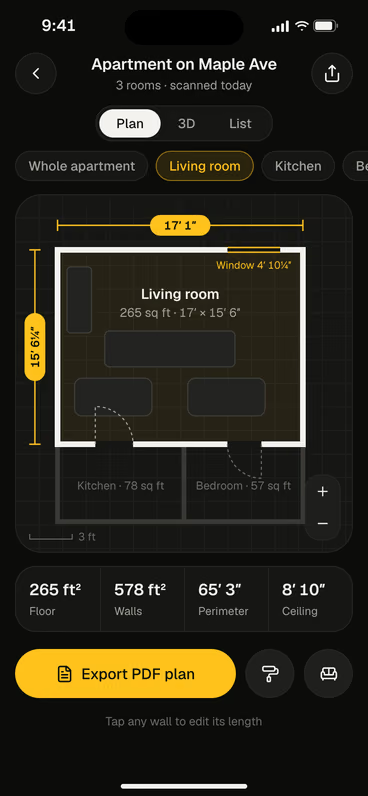
Every wall, in one scan. On a LiDAR iPhone, walk around the bedroom and TapePal draws the floor plan with every wall length, door and window; on other iPhones, tap the floor corners. You get the plan in 2D and 3D, and can export it as a PDF, or as DXF or SVG for CAD. To see whether a king fits before you buy it, Will it fit shows it as a life-size box in AR.

Questions
What is the minimum size for a bedroom?
70 sq ft, and no less than 7 ft in any direction, under the IRC R304. The smallest rectangle that passes is 7 × 10 ft. Local codes can ask for more, and the inspector has the final word.
Is a 10 × 10 room big enough for a queen bed?
Yes. A 60 × 80 in queen against a 10 ft wall leaves 30 in on each side and 40 in at the foot, more than the 24 in walkway. Nightstands and a dresser are what make it tight.
How big is a master bedroom?
About 14 × 16 ft, or 224 sq ft. That fits a king bed with room for nightstands, a dresser and a seat.
What makes a room a legal bedroom?
At least 70 sq ft and 7 ft each way, a ceiling of at least 7 ft over most of the floor, and an escape window or door: an opening of 5.7 sq ft or more, at least 24 in high and 20 in wide, with the sill no higher than 44 in.
Does floor under a sloped ceiling count?
Not where the ceiling is lower than 5 ft. That part of an attic bedroom doesn't count toward the 70 sq ft minimum.
How we checked this. No survey publishes a measured US bedroom average; these are the sizes US home guides agree on. The 11 × 12 ft (132 sq ft) average, the 14 × 16 ft (224 sq ft) primary bedroom, the 120 sq ft secondary bedroom and the 8 × 10 to 10 × 10 ft kids' room are from HomeGuide's average bedroom size guide. The 70 sq ft and 7 ft minimums and the 5 ft sloped-ceiling rule are from the 2021 International Residential Code, R304.1 to R304.3; the 7 ft ceiling from R305.1 and the escape window from R310.2. Bed sizes are the standard US mattress sizes. Local codes can differ. Read 26 Nov 2026. Reviewed by the TapePal team on .